


Key Takeaways:
- Look for clearly separated layers, which come from careful lamination and controlled butter temperature.
- A perfect croissant should have a crisp, golden exterior with a light and evenly aerated centre.
- The honeycomb structure inside reflects how well fermentation, lamination, and baking have worked together.
- Butter should bring richness and flavour without leaving the pastry oily or heavy.
- At Alice Boulangerie, we use a three-day process and French AOP butter for our signature croissants, giving us time to develop the flavour, crunch, and chew we look for.
Introduction
A croissant may appear simple, yet its quality depends on several precise details working together. Some feel light and crisp with distinct layers, while others feel dense, uneven or overly dry.
For us, those differences begin with how we prepare the dough, laminate the butter, manage fermentation, and bake the finished pastry. Each stage affects the layers, rise, texture, and flavour you experience in the final croissant.
Understanding what defines a perfect croissant allows you to recognise the balance between flakiness, softness and richness. These qualities also provide a useful reference when choosing pastries from Singapore cafés, bakeries, or breakfast spreads.
The Role of Lamination in Creating Flaky Layers
How Butter Layers Form the Structure of a Croissant
The defining feature of a croissant is its laminated dough layers, created by repeatedly folding sheets of butter into the dough. During baking, moisture in the butter turns into steam, separating the folds and creating the pastry’s flaky structure.
In our kitchen, controlling the butter and dough temperature is an important part of this process. The butter needs to remain firm enough to stay in distinct layers, while still being flexible enough to roll with the dough.
When this process is handled correctly, the layers remain visible and evenly distributed rather than compressed. Temperature control is equally important, as butter that becomes too soft may absorb into the dough rather than remain in defined sheets.
Alice Boulangerie’s signature croissants are made over three days and use French AOP (Appellation d’Origine Protégée) butter, giving the pastry time to develop flavour, crunch and the right amount of chew.
Why Even Layering Affects Texture and Appearance
Consistent layering helps the croissant bake evenly from its outer crust to its centre. Uneven lamination may create dense sections, exposed butter or areas that collapse after baking.
We look for layers that rise together and produce a clean, defined structure. When the folds remain even, the croissant is more likely to develop the crisp exterior and airy centre we want.
Understanding Flakiness Beyond the Surface
What Creates a Crisp Outer Layer
A well-made croissant develops a crisp golden exterior that holds its shape without becoming overly hard. For us, the exterior should feel delicate rather than thick or brittle. A few flakes are expected when you tear into the pastry, but it should not crumble excessively or feel dry throughout.
How Flakiness Connects to the Interior
Flakiness is not limited to the outer shell. It also reflects how thoroughly the layers have separated inside the pastry. When you pull our croissant apart, we want you to see distinct folds and air pockets rather than a compressed centre. The contrast between the crisp shell and soft interior is part of what gives the pastry its character.
Croissants that have a crisp surface paired with a heavy interior may indicate that the pastry browned properly on the outside but did not develop enough internal lift.
Balancing Softness With Structure
Achieving a Light and Airy Interior
The interior should feel light and soft, creating a clear contrast with the crisp exterior. Proper fermentation allows air pockets to develop before baking, while heat expands these pockets alongside the butter layers.
Our three-day process allows us to manage fermentation and lamination gradually, giving the dough time to develop while we monitor its strength, temperature, and structure at each stage. This preparation is also why pre-orders are important to us. They allow our team to plan the required production time properly and bake fresh each day, rather than rushing the stages that contribute to the croissant’s final texture and quality.
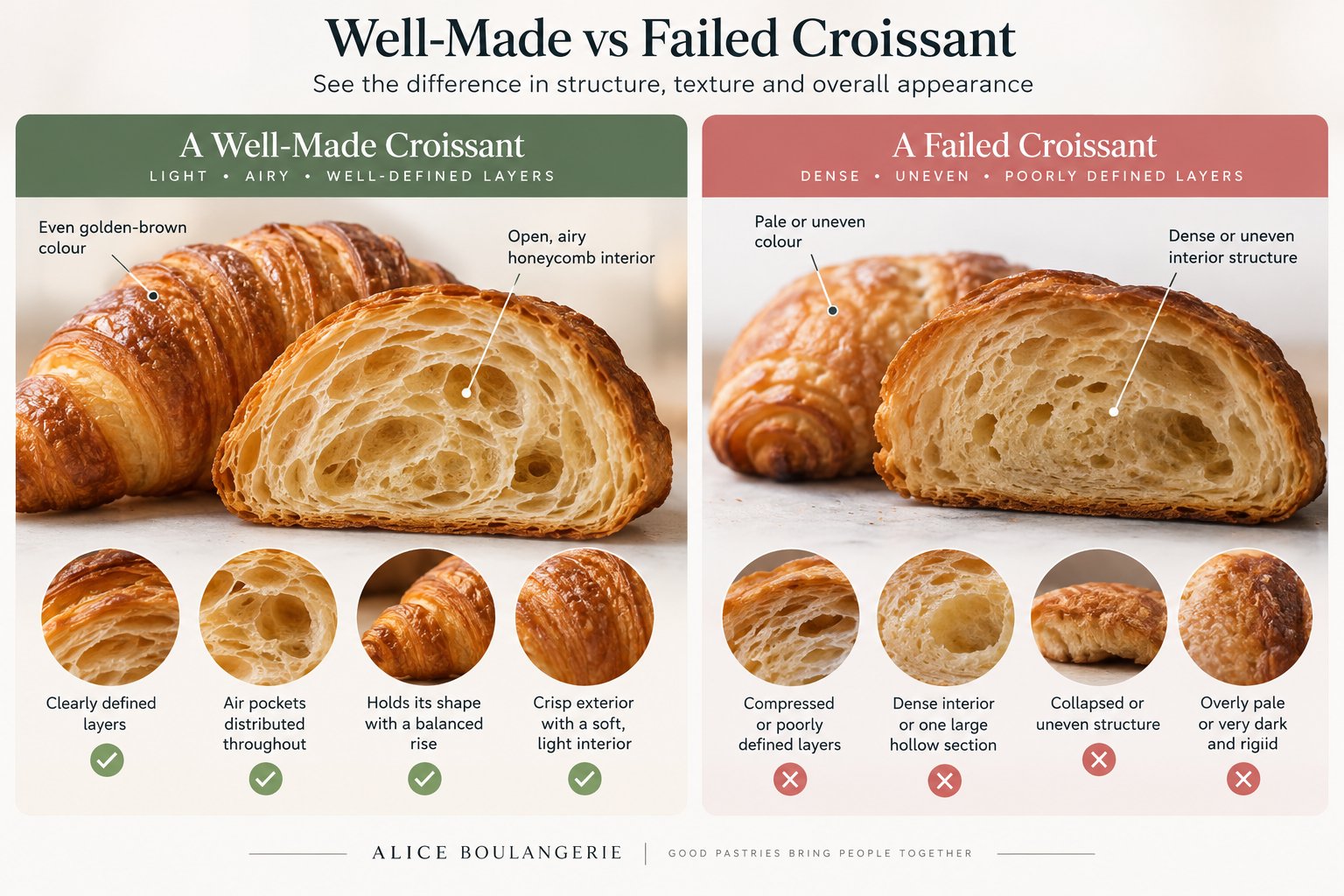
The result is the open honeycomb crumb structure we look for in a well-made croissant, with air pockets distributed throughout the pastry rather than concentrated in one large hollow section.
Avoiding Density or Collapse
A compact interior may result from insufficient fermentation, compressed folds or butter melting into the dough too early. Weak internal structure can also cause the croissant to collapse after leaving the oven.
These are details we watch closely during production. The finished croissant should maintain its shape while remaining soft inside, with enough structure to support the layers without becoming tough.
The Importance of Butter in Texture and Flavour
How Butter Separates the Layers
Butter contributes to both structure and flavour. As it heats, its moisture creates the steam that separates the dough layers and supports the croissant’s rise.
AOP butter has a firm yet workable texture that makes it well suited to lamination. At Alice Boulangerie, we therefore choose the type and brand of butter we work with carefully, considering not only how it performs as we roll and fold the dough, but also the flavour it contributes to the finished croissant. The butter needs to remain in distinct, even sheets rather than softening into the dough, helping us maintain clear separation between the layers so they can expand evenly during baking. This careful selection supports both the laminated structure and the rich, balanced buttery flavour we want in the final pastry.
Why Butter Influences Mouthfeel
Butter also gives the croissant its richness and smoothness. A balanced buttery pastry texture should complement the toasted crust and soft centre without making each bite feel greasy or overwhelming.
An oily coating on the hands or palate may indicate that too much butter escaped from the layers rather than remaining integrated into the pastry.
Recognising a Well-Made Croissant at a Glance

Observing Shape, Rise and Colour
A perfect croissant shows a balanced rise and holds its form without collapsing at the base. The layers should expand evenly instead of separating excessively around the edges.
We also look for an even golden-brown finish. Pale areas can suggest uneven baking, while very dark or rigid edges may make the pastry feel too dry.
Noticing Layer Definition
When the croissant is gently torn or cut, its interior should reveal distinct yet connected layers. Air pockets should be distributed throughout rather than clustered in one section.
These are some of the same qualities we check in our own croissants: clear layers, an open centre, an even bake, and a texture that moves from crisp outside to soft inside.
How Croissant Quality Relates to Other Layered Pastries
Recognising Lamination Across the Pastry Display
The technique used for croissants also forms the foundation of other laminated pastries. Pain au chocolat relies on folded dough and butter layers surrounding a chocolate centre, while Danish pastries use a related structure shaped around different fillings. For our Pain au Chocolat, we also carefully select the chocolate baton used within those layers, considering how its flavour and richness work with the buttery laminated dough. The same attention applies to the ingredients we use across our pastries, as even a well-made dough can benefit from fillings and ingredients chosen to complement and elevate its overall flavour.
The same attention to dough handling, butter temperature, and layer definition can be seen across laminated bakes.
Similar quality markers can be found across French pastries that Singapore diners enjoy.
Using the Croissant as a Practical Benchmark
The croissant is often considered a classic benchmark of a French bakery because it brings together fundamentals of traditional pastry-making in a familiar form. Its quality depends on layering, fermentation, shaping, and baking, with each stage leaving visible and textural signs that customers can assess without specialist baking knowledge.
However, a croissant should not be the only measure of a bakery’s standards here at Alice Boulangerie. Different pastries require different doughs, fillings and methods. For us, the croissant is one expression of pastry craft. Its layers make the effects of timing, temperature, fermentation, and shaping especially easy to see and taste.
Appreciating Texture and Detail in Every Bite
A well-made croissant is defined by the way its layers separate, the gentle shift from crisp shell to tender centre, and the richness of butter that remains balanced. Our three-day process and use of French AOP butter are part of how we build those qualities into our signature croissants. We look for a crisp golden exterior, visible lamination, an airy centre, and enough chew to give the pastry structure.
Recognising these details makes it easier to identify a perfect croissant and appreciate the preparation behind it. Customers looking to enjoy freshly prepared bakes at home or at work may also consider croissant delivery for breakfasts, meetings and casual gatherings.
Visit us at Alice Boulangerie to try our croissants and experience the layers, texture, and flavour we work to achieve in every bake.